
Microwave Motion Sensor Light for Smart and Automated Lighting
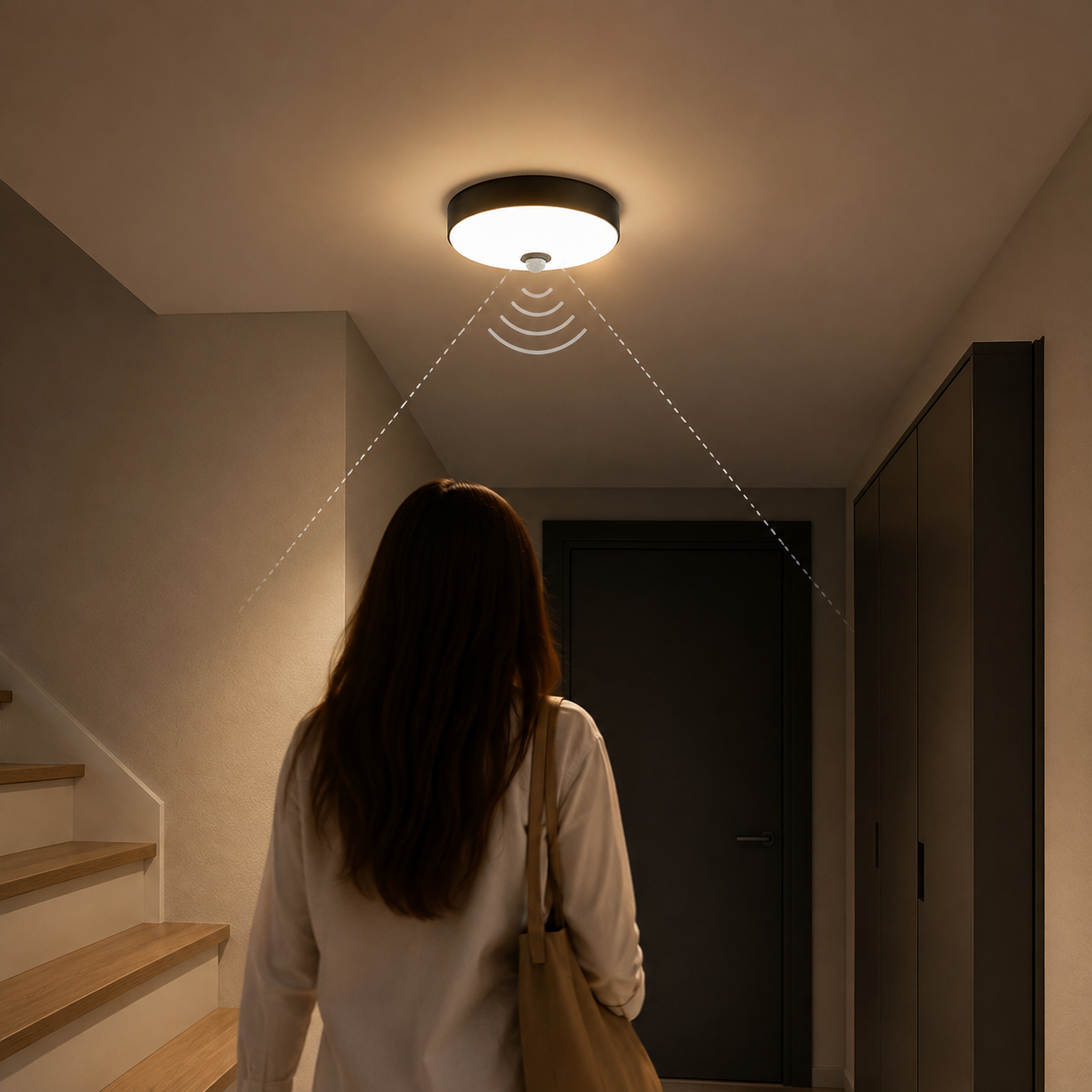
A Microwave Motion Sensor Light combines LED lighting with an active microwave detection system that identifies movement within a defined area. The sensor sends microwave signals and detects changes in the reflected signals caused by moving objects or people. Based on settings such as sensitivity, detection range, and hold time, the system can switch lights on, maintain illumination, dim the output, or activate other programmed functions.
Microwave sensor lighting is suitable for spaces where occupancy changes frequently and continuous full-power illumination is not always required. Corridors, staircases, warehouses, parking areas, offices, storage spaces, utility rooms, and commercial facilities can use motion-based lighting control to provide illumination when movement is detected .
Proper selection requires consideration of mounting height, detection coverage, environmental conditions, false-trigger risks, LED driver compatibility, sensitivity settings, and the required control sequence. Evaluating these technical factors before installation helps achieve dependable motion detection, consistent lighting response, and efficient operation for the intended application.
Smart Lighting Solutions for Energy-Conscious Applications
Saffron follows a practical, application-focused approach to sensor-based lighting, with emphasis on detection accuracy, LED compatibility, installation conditions, control requirements, and the specific needs of each space. A Microwave Motion Sensor Light should not be selected based only on appearance or basic motion detection. Important technical factors such as detection range, mounting height, sensitivity, hold time, standby mode, detection angle, and lighting response should be evaluated before installation. Matching these specifications with the intended application helps minimise unwanted switching and supports consistent lighting performance during regular use.
Saffron follows a practical, application-focused approach to sensor-based lighting, with emphasis on detection accuracy, LED compatibility, installation conditions, control requirements, and the specific needs of each space. A Microwave Motion Sensor Light should not be selected based only on appearance or basic motion detection. Important technical factors such as detection range, mounting height, sensitivity, hold time, standby mode, detection angle, and lighting response should be evaluated before installation. Matching these specifications with the intended application helps minimise unwanted switching and supports consistent lighting performance during regular use.
Reliable performance also depends on compatibility between the microwave sensor, LED fixture, driver, control system, and electrical installation. Saffron considers these technical requirements while selecting and configuring sensor-based lighting solutions, helping ensure that the system responds appropriately to movement and operates according to the requirements of the application. Proper mounting position, ambient light conditions, control logic, standby settings, and installation practices should be reviewed as part of the overall planning process. This application-driven approach supports dependable operation, efficient lighting control, and a more practical sensor lighting solution for residential, commercial, industrial, and utility environments.
How Microwave Motion Sensor Light Works and Detects Movement
A microwave sensing system continuously emits low-power electromagnetic waves into a defined detection area and analyses the signals reflected from surrounding objects. When a person or object moves, the reflected signal changes, allowing the sensor to identify movement and send a corresponding control signal to the connected lighting system. Unlike PIR sensors, which respond to changes in infrared radiation from moving warm objects, microwave sensing is based on changes in the reflected electromagnetic signal.
Detection performance depends on factors such as sensor sensitivity, mounting height, detection range, surrounding structures, and the movement pattern within the monitored area. Excessive sensitivity or unsuitable positioning may result in unwanted detection beyond the required zone, while insufficient sensitivity can reduce reliable activation. Proper installation, configuration, testing, and commissioning help establish the intended detection boundary and support consistent lighting control during normal operation.
Key Components of a Microwave-Based Lighting System
LED Light SourceThe LED module provides illumination and determines lumen output, color temperature, CRI, efficiency, and operating life. Lighting performance should be evaluated together with the sensor system.
Microwave Motion SensorThe sensor detects movement within a defined area. In a Microwave Motion Sensor Light, detection range and sensitivity should match the room size, mounting height, movement pattern, and surrounding objects.
Driver and Control SystemThe LED driver regulates power to the light source. Sensor and driver compatibility is important for switching, dimming, standby levels, and other automatic controls.
Housing and Optical SystemThe housing protects internal components, while the diffuser, lens, or reflector controls light distribution. Proper optical design helps provide useful and comfortable illumination.
Key Advantages of Microwave Motion Sensor Light Technology
Motion-based lighting can reduce unnecessary illumination by activating or adjusting the light when movement is detected within a defined area. This can be useful in corridors, staircases, warehouses, parking areas, storage zones, utility spaces, and other intermittently occupied locations. Properly configured detection can help align lighting operation with actual occupancy patterns rather than keeping fixtures at full output continuously.
Another benefit is automated operation, which reduces the need for frequent manual switching. Microwave-based detection can respond to movement within its configured sensing field and can be integrated with lighting controls that support switching, dimming, or standby illumination. This provides greater flexibility when lighting requirements change between occupied and unoccupied periods.
Performance also depends on correct specification and installation. Detection range, sensitivity, mounting height, surrounding structures, control settings, driver compatibility, and the intended coverage area should be evaluated together. Proper commissioning and testing can help minimise unwanted activation while maintaining reliable detection and consistent lighting control.
Step-by-Step Guide to Selecting the Right Motion Sensor Lighting
Step 1 Identify the Lighting RequirementDefine whether the system is required for automatic switching, occupancy-based dimming, standby lighting, or energy management. The control objective should be clear before selecting the fixture.
Step 2 Assess the Installation AreaReview room dimensions, ceiling height, partitions, doors, racks, furniture, equipment, and nearby movement. These conditions influence the suitable detection coverage.
Step 3 Determine the Detection RangeChoose a detection range that covers the required zone without unnecessarily extending into adjacent areas. Controlled coverage is more important than maximum range.
Step 4 Select the Lighting OutputDetermine the required lumen output, color characteristics, and light distribution according to the application. The lighting performance should be assessed separately from sensor coverage.
Step 5 Check System CompatibilityFor a Microwave Motion Sensor Light, verify compatibility between the sensor, LED driver, fixture, dimming controls, and other connected components, particularly when standby or dimming functions are required.
Step 6 Configure Sensitivity and Hold TimeSet sensitivity and hold time according to the space and expected movement. Test normal, slow, and boundary-area movement after installation.
Step 7 Test the Detection ZoneWalk through entrances, corners, work areas, and boundary zones to confirm that movement is detected where required and unwanted areas remain outside the active zone.
Step 8 Fine-Tune the SystemAdjust sensitivity, positioning, detection range, or timing where necessary. Proper commissioning helps minimise false activation and supports consistent automatic lighting control.
Why Choose Saffron for Microwave Motion Sensor Light Solutions
Saffron focuses on application-specific LED lighting solutions where sensor performance, electrical compatibility, optical output, and installation conditions are considered together. Product selection is based on the intended use of the space, required illumination, detection coverage, mounting conditions, and control requirements rather than relying only on standard specifications.
For projects using sensor-controlled lighting, technical factors such as detection range, sensitivity, hold time, standby settings, driver compatibility, dimming requirements, and fixture performance require careful evaluation. Saffron's approach considers these parameters to help identify configurations that are appropriate for offices, warehouses, corridors, parking areas, commercial facilities, and other intermittently occupied spaces.
Reliable operation also depends on correct installation, configuration, and commissioning. Reviewing the actual detection zone, testing movement patterns, adjusting sensor settings, and checking system compatibility can help reduce unwanted activation and improve consistency. This practical focus supports lighting solutions designed around real installation requirements and everyday operating conditions.
Microwave Motion Sensor Light for Smarter and More Efficient Lighting
A microwave-based sensor lighting system can provide automated illumination by responding to movement within a defined detection area. Its effectiveness depends on the combination of sensor technology, LED performance, optical design, driver compatibility, and control settings. When these elements are matched to the application, the system can support convenient and responsive lighting operation.
Successful implementation requires more than selecting a fixture with a suitable sensor. Detection range, sensitivity, mounting height, hold time, standby settings, surrounding structures, lighting output, and electrical compatibility should be evaluated before installation. Proper testing and commissioning are also important for establishing the intended detection zone and reducing unwanted activation.
For commercial, industrial, warehouse, corridor, parking, office, and utility applications, a well-specified Microwave Motion Sensor Light can support occupancy-based lighting control and reduce unnecessary operation. Reviewing the actual site conditions and configuring the system according to movement patterns and lighting requirements helps achieve reliable performance, practical energy management, and consistent day-to-day operation.