
Understanding Smart LED Tuya Mesh Lighting
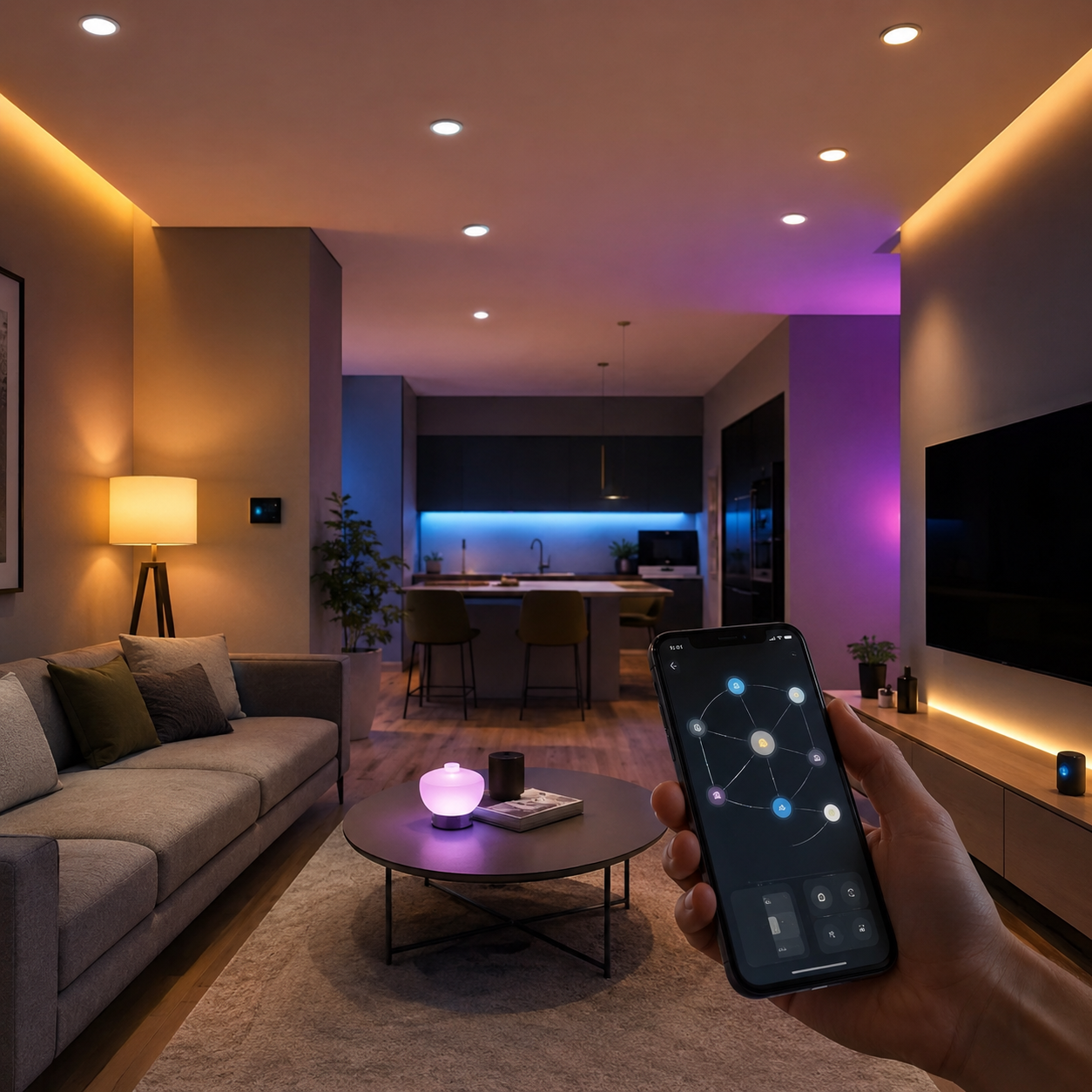
Smart LED Tuya Mesh Lighting combines LED illumination with mesh-based wireless communication to provide coordinated control across multiple lighting points. Instead of treating every light as an isolated device, mesh networking allows compatible lighting nodes to communicate within a connected network. Tuya describes its mesh architecture as a system where multiple devices form a network and users can access and control devices through the connected mesh.
For residential, commercial, office, hospitality, and other connected lighting applications, this approach can simplify group control and create more flexible lighting scenarios. The actual system design still needs to consider the LED configuration, communication requirements, installation environment, control method, and number of connected devices before implementation.
How Tuya Mesh Technology Works in Smart Lighting
Smart LED Tuya Mesh Lighting uses multiple connected lighting devices as nodes within a network instead of relying on a separate direct connection between a phone and every individual light. The devices can communicate across the mesh, allowing commands to be distributed between connected lighting points. This approach is useful where multiple fixtures require coordinated operation, grouped control, or scene-based lighting management.
For lighting manufacturers and system designers, the mesh architecture provides a practical foundation for developing connected lighting products. Tuya's smart lighting solutions support functions such as individual and group control, brightness adjustment, color temperature control, color lighting, automation, and sensor-based scenarios depending on the product configuration.
Key Features of Smart LED Tuya Mesh Lighting
A major value of mesh-based lighting is coordinated control. Multiple lighting points can be grouped according to rooms, zones, fixtures, or application requirements. This allows users to manage lighting as a system instead of operating every fixture separately. Tuya's lighting solutions include one-button group control and scenario-based operation for connected lighting environments.
Depending on the selected product and configuration, smart lighting can also support brightness adjustment, tunable color temperature, RGB or multi color operation, timers, scene control, and sensor-based automation. These functions allow the lighting system to be configured around actual usage requirements rather than relying only on conventional on/off switching.
Smart Lighting Applications for Different Environments
Smart LED Tuya Mesh Lighting can be considered for homes, offices, commercial spaces, hospitality environments, retail areas, restaurants, and other locations where multiple lighting points require coordinated control. Tuya specifically identifies home, commercial, office, and outdoor lighting among the application scenarios for its mesh-based lighting solutions.
The appropriate configuration depends on the project. A residential installation may prioritise scene control and convenience, while an office or commercial project may require zone-based control, scheduling, sensor integration, and management of a larger number of lighting nodes. Designing around the actual application helps avoid unnecessary features and improves system compatibility.
Benefits of Using Smart LED Tuya Mesh Lighting
The main practical advantage is the ability to coordinate multiple lighting devices through a connected network. This can make group control, scene creation, and automation more manageable, particularly where a project contains numerous lighting points. Mesh communication can also reduce dependence on a direct point-to-point connection between the controller and every light.
Another advantage is the possibility of local network operation in supported configurations. Tuya documents solutions where local Bluetooth mesh control can continue even when internet connectivity is unavailable, while gateway-based configurations can provide additional remote-control and integration capabilities.
Smart Lighting Control and Automation
Automation becomes more useful when lighting is designed around specific operating conditions. Lights can be grouped into scenes or linked with sensors and other devices where the selected system supports those functions. For example, motion detection, brightness detection, scheduled operation, or predefined lighting scenes can be incorporated into suitable smart lighting configurations.
This approach can be particularly useful in commercial and institutional environments where lighting requirements change throughout the day. Smart LED Tuya Mesh Lighting can support predefined control logic for managing lights according to occupancy, time, zone, or activity, reducing the need to adjust individual fixtures manually.
Step-by-Step Approach to Implementing Smart LED Tuya Mesh Lighting
1: Define the Lighting RequirementStart by identifying the type of LED fixtures, number of lighting points, required brightness, color or color-temperature requirements, and intended application. This establishes the basic technical requirements before selecting the smart lighting architecture.
2: Determine the Network ConfigurationThe next step is to determine how the lighting nodes will communicate and whether the application requires gateway-based remote access. Tuya supports different mesh configurations, including mesh devices that can operate without a gateway and gateway-based arrangements for additional functionality.
3: Configure Lighting FunctionsRequired functions should then be defined, such as dimming, color temperature adjustment, RGB control, group control, scheduling, scenes, or sensor integration. Not every product supports every function, so these requirements should be confirmed during product selection.
4: Test the Connected Lighting SystemTesting should cover pairing, individual light control, group operation, communication between nodes, scene execution, power restoration behaviour, and any required sensor or gateway functions. Tuya's development documentation also provides dedicated procedures for pairing, configuration, hardware commissioning, and product testing.
5: Deploy and Validate the InstallationAfter configuration and testing, the complete lighting system should be evaluated under actual installation conditions. Physical obstructions, network layout, fixture positioning, electrical supply, and environmental conditions can influence real-world performance, so validation should be completed before full-scale deployment.
Smart LED Tuya Mesh Lighting and Future-Ready Lighting Design
Connected lighting is increasingly being designed as part of a wider smart-building or smart-home ecosystem rather than as an isolated lighting system. Tuya's smart lighting platform supports integration with other connected devices and automation functions, allowing lighting to participate in broader IoT applications.
For manufacturers and project developers, Smart LED Tuya Mesh Lighting can provide opportunities to develop lighting products with configurable controls and connected functionality. However, future-ready solutions should be based on actual project requirements, supported protocols, hardware compatibility, and the expected operating environment rather than adding features without a defined application.