
COB Spot Light for Modern Interior Lighting Solutions
Choosing the right lighting can transform a residential interior, retail showroom, hotel, office or commercial space. A COB spot light is a popular option for directional illumination, accent lighting and highlighting selected areas. Its compact LED light source can be combined with different lenses and reflectors to create a variety of lighting effects.
However, selecting the right fixture involves more than checking its wattage or appearance. Beam angle, lumen output, colour temperature, colour rendering, driver compatibility and heat dissipation all influence performance.
In this guide, we explain how COB LED technology works, explore its applications, compare different spotlight designs and provide a practical buying checklist for architects, interior designers, electrical contractors, builders and procurement professionals.
What Is a COB Spot Light?
COB stands for Chip-on-Board, an LED packaging technology in which multiple LED semiconductor chips are mounted closely together on a common substrate. These chips are integrated into a compact light-emitting assembly that often appears as a single illuminated surface.
A COB spot light combines this light source with a luminaire housing, electrical driver and optical components designed to distribute light according to the intended application.
Depending on the design, these components may include:
- Reflectors: Redirect light and help shape its distribution.
- Lenses: Control the beam angle and concentration of light.
- Diffusers or protective covers:Influence the appearance and distribution of light.
- Heat-dissipation components: Transfer heat away from the LED assembly.
Unlike lighting products that use separate, visibly spaced LED packages, a COB LED source generally provides a more compact emitting area. This can support streamlined luminaire designs and controlled directional lighting.
However, COB technology does not automatically produce a narrow beam. A recessed COB downlight may distribute light relatively widely, while a COB track spotlight with suitable optics may produce a more concentrated beam.
When choosing a LED COB spot light evaluate the complete fixture rather than its LED packaging alone.
How Does COB LED Spotlight Technology Work?
A COB spotlight converts electrical energy into visible light through semiconductor LED chips. Its overall performance depends on how the LED source, driver, thermal design and optics work together.
The process involves five main elements.
- Electrical supply: A compatible LED driver supplies the electrical conditions required by the LED module. The required constant-current or constant-voltage arrangement depends on the module design.
- Light generation: When electrical current flows through the LED chips, they generate light. Phosphor conversion is commonly used in white LED sources.
- Thermal management: The luminaire's substrate, housing and heat sink, where provided, help dissipate heat produced during operation.
- Optical control: Lenses and reflectors shape the light output to create the intended beam distribution.
- Light delivery: The completed fixture directs light towards the target area, such as a product display, artwork, counter or architectural feature.
The driver must match the LED module's electrical requirements. Operating temperature, component quality, ventilation and dimming compatibility also affect reliability.
The performance of the complete fixture depends on the LED source, driver, optics, thermal design and manufacturing quality
For further background on LED performance, efficiency and colour characteristics, refer to the U.S. Department of Energy's LED Basics guide
Key Benefits of COB Spot Light
Focused and Directional IlluminationSuitable lenses and reflectors allow a COB spotlight to direct light towards selected surfaces and objects. This is useful for highlighting artwork, merchandise, decorative walls, architectural details or work areas
For example, a retail designer may use a narrower beam to emphasise an individual product and a wider beam to illuminate a larger display. The appropriate choice depends on mounting height, distance and the size of the target area.
Compact Lighting DesignThe compact emitting surface of a COB LED can support contemporary spotlight designs with relatively small visible apertures.
Recessed and concealed versions can integrate neatly into ceilings, while surface-mounted and track-mounted models provide alternative installation arrangements.
The final appearance depends on the fixture housing, dimensions, trim, mounting method and optical assembly.
Accent and Display LightingCOB spotlights are suitable for applications where selected visual elements need to stand out.
Common examples include artwork in homes, garments in clothing stores, products in showrooms, decorative niches in hotels and feature walls in commercial interiors.
Correct positioning is important. Poor aiming can produce distracting reflections, harsh shadows or excessive brightness on reflective surfaces.
Energy EfficiencyLED technology offers opportunities for efficient lighting, but actual performance varies between products.
When comparing spotlights, examine luminaire efficacy, measured in lumens per watt (lm/W). This indicates how much light the complete fixture delivers relative to the electrical power it consumes.
A higher value may indicate better energy performance when comparing otherwise suitable fixtures under comparable conditions. However, beam distribution, colour quality and visual comfort must also meet the project's requirements.
Refer to the U.S. Department of Energy's LED Basics guide for additional information on LED performance.
Lighting Design FlexibilityCOB spotlights are available in different form factors, mounting styles, beam angles and colour temperatures.
Depending on the model, buyers may also have access to adjustable heads, directional track systems or dimming options.
This flexibility allows lighting designers to coordinate ambient, accent and task lighting within the same project.
Maintenance and Service LifeLED fixtures can offer long operating life, but maintenance requirements depend on the complete product.
LED quality, driver reliability, operating temperature, installation conditions and component serviceability all matter. Before purchasing, review the manufacturer's stated lifetime information, warranty conditions and replacement arrangements.
Do not assume that every COB fixture has the same lifespan simply because it uses COB technology.
Different Types of COB Spot Light
The most suitable type depends on the ceiling construction, aiming requirements, visual effect and installation environment.
Recessed COB Spot Light
A recessed COB spotlight is installed inside a ceiling cavity, leaving the visible fixture integrated with the ceiling surface.
Typical applications include:
- Living rooms and bedrooms
- Hotel corridors and reception areas
- Offices and meeting spaces
- Retail interiors
- Decorative ceiling features
Before installation, check the cut-out diameter, fitting depth, ceiling material and required clearance. Driver placement and access for maintenance should also be planned.
Surface-Mounted COB Spot Light
Surface-mounted fixtures attach directly to a ceiling or suitable mounting surface. They are useful when the ceiling does not provide enough cavity depth for recessed lighting or where a surface-mounted appearance is preferred.
They can be used in homes, shops, offices and selected commercial interiors.
Review the fixture's dimensions, mounting arrangement, adjustability and heat-dissipation design before specifying it.
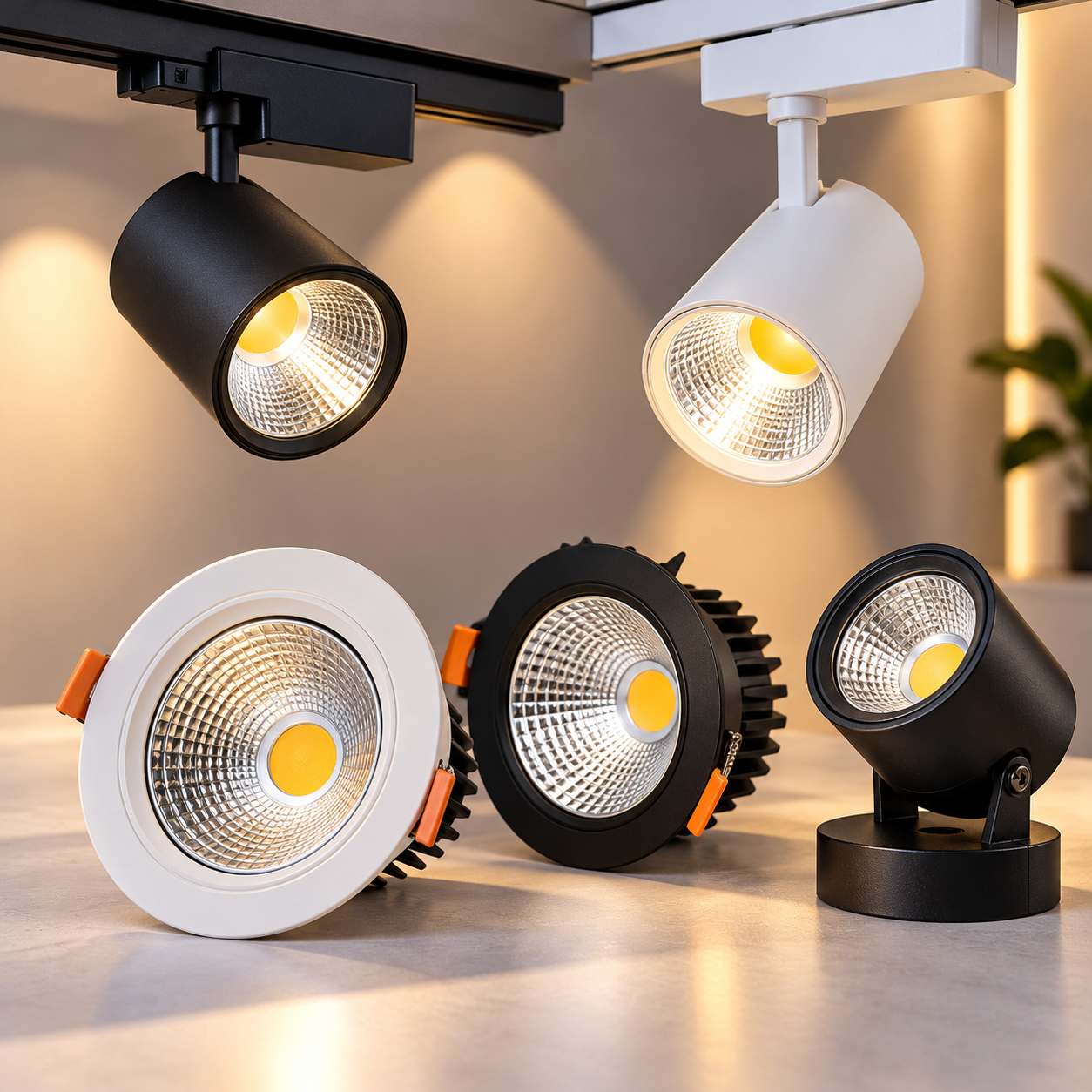
COB Track Light
A COB track light is attached to a compatible track system and can generally be aimed towards selected areas.
Track lighting is particularly useful in galleries, retail stores, showrooms and changing display environments because light positions can be adjusted to suit the layout.
For installations requiring flexible product highlighting, consider the COB Track Light from Saffron Power Innovations.
Confirm track compatibility, electrical requirements, beam angle and colour temperature against the selected model's specifications.
Adjustable or Zoom COB Spotlight
Some COB spotlights have adjustable heads that allow the direction of the light to be changed. Other specialised models provide zoom optics that change the beam angle.
These are different functions: an adjustable head changes where the fixture points, while zoom optics change the beam spread.
Zoom functionality is model-specific and should not be assumed to be available in every spotlight.
COB Hanging Spotlight
A hanging COB spotlight is suspended from the ceiling, creating a visible lighting element while directing light towards a chosen area.
It may suit hospitality interiors, selected commercial spaces, counters and architectural applications where suspended fixtures complement the design.
Review suspension height, glare control, maintenance access and the intended illumination area.
Explore the COB Hanging Light from Saffron Power Innovations for a product-specific example.
Product availability, wattage, dimensions, colour options and mounting features vary by model. Always consult the manufacturer's current product information.
Applications of LED COB Spot Light
Residential LightingAn LED COB spotlight can highlight artwork, decorative niches, textured walls, dining areas and kitchen work zones.
In a living room, directional fixtures can emphasise selected features while other luminaires provide general illumination. Avoid placing intense beams where they are likely to cause discomfort when occupants are seated or lying down.
Retail and Showroom LightingRetail environments use directional lighting to attract attention to merchandise, mannequins, shelves and feature displays.
A suitable COB fixture can help create visual contrast between a product and its surroundings. Colour rendering is especially important where shoppers need to judge merchandise colours accurately.
Hospitality LightingHotels, restaurants and reception areas may use spotlights to highlight counters, wall finishes, decorative objects and architectural details.
The selected fixture should complement the overall lighting scheme while managing reflections, glare and contrast between bright and dark areas.
Hospitality Lighting Office and Commercial LightingCOB spotlights may be appropriate for reception counters, meeting-room features, display areas and selected task-lighting applications.
For desks and workstations, verify that the lighting layout provides suitable illumination and visual comfort rather than simply creating bright spots.
Galleries and Architectural LightingArt galleries, showrooms and architectural interiors often require controlled light distribution to emphasise particular objects or surfaces.
Check colour quality, beam spread, aiming flexibility and the possibility of unwanted reflections. Where conservation-sensitive objects are involved, confirm the specific lighting requirements before finalising the fixture.
Across all applications, the final selection should consider glare, visual comfort, colour rendering, thermal conditions and the lighting requirements of the space.
How to Choose the Right COB Spot Light
Use the following buying checklist when evaluating a spotlight for a residential, commercial or architectural project.
1. Check Wattage and Light Output
Wattage indicates electrical power consumption, while lumens indicate total light output.
Do not select a fixture using wattage alone. Compare lumen output and luminaire efficacy, then consider where the light will fall and whether the fixture delivers the required illumination at the target surface.
2. Select the Correct Beam Angle
Beam angle affects the spread of light.
- Narrow beam:Useful for concentrated accent lighting and selected displays.
- Medium beam: Suitable for many general accent-lighting applications.
- Wide beam: Useful for broader coverage of walls, counters and selected work areas.
These descriptions are general, not universal classifications. Always compare the manufacturer's stated beam angle and photometric data.
A beam that is too narrow may create harsh bright spots, while one that is too wide may reduce the intended accent effect.
3. Choose the Right Colour Temperature
Correlated colour temperature (CCT), measured in kelvin (K), describes the appearance of white light.
| Colour temperature | Typical appearance | Potential applications |
|---|---|---|
| 2700–3000 K | Warm white | Homes, restaurants and relaxing interiors |
| 3500–4000 K | Neutral white | Offices, showrooms and contemporary interiors |
| 35000–6500 K | Cool white or daylight-like | Selected commercial and task-oriented environments |
4. Review Colour Rendering Index (CRI)
CRI describes how a light source renders colours in comparison with a reference light source.
Higher CRI can be important in clothing stores, artwork displays and other environments where colour appearance matters. A specification of CRI 80 or above is a useful starting point for many indoor applications, while CRI 90 or above may be preferred where more faithful colour rendering is important.
For demanding colour-critical applications, ask whether additional colour-quality data, such as R9 or TM-30 metrics, is available.
5. Check the LED Driver
The driver must match the LED module's electrical requirements.
Confirm the input supply range, output current or voltage, rated power, protection features and compatibility with the fixture. If dimming is required, verify compatibility between the driver, dimmer and control system.
A fixture should not be assumed to be dimmable merely because LEDs can support dimming.
6. Evaluate Thermal Management
LED performance can be affected by operating temperature. Check the housing material, heat-dissipation arrangement and any manufacturer-specified temperature limits.
Ensure that the fixture is installed with the clearances and ventilation required by its instructions. Avoid placing it in a restricted ceiling cavity unless the manufacturer confirms that the installation is suitable.
7. Verify Installation and Safety Requirements
Before ordering, confirm:
- Recessed cut-out dimensions and fixture depth, where applicable.
- Mounting and ceiling compatibility.
- Required insulation clearance and ventilation.
- Electrical ratings and installation instructions.
- IP rating appropriate to the environment.
- Applicable safety documentation and certifications.
Do not assume that an indoor spotlight is suitable for outdoor or damp locations. The required protection depends on the installation environment.
8. Review Warranty and Technical Support
For a project or bulk purchase, request the current product datasheet and written warranty terms.
Confirm the rated specifications, applicable certifications, consistency between supplied units, spare-part arrangements and available after-sales support. Where lighting calculations are important, ask for photometric files or other relevant test documentation.
COB Spot Light vs Conventional LED Spotlight
| Comparison factor | COB spot light | Other LED spotlight designs |
|---|---|---|
| Light source | Closely arranged LED chips on a substrate | May use discrete LEDs or other LED arrangements |
| Appearance of light source | Often appears as a compact emitting surface | Depends on the LED packaging and optical design |
| Beam control | Depends on reflectors, lenses and fixture design | Depends on the optical system |
| Applications | Accent, display, task and directional lighting | Varies by fixture type |
| Energy performance | Depends on complete fixture efficacy | Depends on complete fixture efficacy |
| Maintenance | Depends on LED, driver, thermal design and serviceability | Depends on product construction and components |
A COB spotlight may provide a compact emitting surface that suits a particular design, but COB technology alone does not guarantee higher efficiency, longer life or superior beam quality.
When evaluating a spotlight COB design against another LED spotlight, compare published specifications and photometric data under comparable conditions.
Common Mistakes to Avoid When Buying a COB Spotlight
Choosing Wattage Without Checking LumensCompare actual light output and efficacy instead of assuming that more watts always mean better illumination.
Selecting an Unsuitable Beam AngleConsider ceiling height, target size, viewing distance and the intended effect before deciding on the optics.
Ignoring Glare and Visual ComfortCheck the fixture's position, aiming direction and optical shielding, particularly in spaces occupied for long periods.
Overlooking CRI and Colour TemperatureMatch light colour and colour-rendering quality to the materials, products and activities in the space.
Using an Incompatible Driver or DimmerVerify electrical ratings and control compatibility before connecting the fixture.
Ignoring Heat DissipationFollow the installation instructions and confirm suitable clearance and ventilation.
Assuming Every Fixture Is Suitable OutdoorsCheck the IP rating and installation requirements for damp, wet or exposed locations.
Purchasing Without Reviewing DocumentationRequest a datasheet, warranty information and applicable safety documentation before committing to a bulk order.
Avoiding these mistakes helps improve lighting suitability, installation reliability and long-term project value.
Why Choose a Reliable COB Spot Light Manufacturer?
Selecting a manufacturer is important because a spotlight's performance depends on the LED source, optics, driver, thermal design and manufacturing consistency working together.
According to its official company profile,> Saffron Power Innovations Pvt. Ltd. has been involved in SMPS and LED driver manufacturing since 1999. Its website lists LED COB lights, concealed COB lights, track lights, surface lights, hanging lights and LED drivers among its product offerings.
Explore the company's LED COB lighting range and LED driver and SMPS range.
When evaluating Saffron or any other manufacturer for a project, consider the following factors:
- Product specification transparency: Confirm the rated wattage, lumen output, beam angle, CRI, colour temperature and dimensions for the exact model.
- Driver compatibility: Verify that the electrical components are suitable for the LED module and intended control system.
- Manufacturing quality: Ask about quality checks, production consistency and relevant product testing.
- strong>Technical information: Review the current datasheet and installation instructions.
- Warranty and support: Confirm written warranty conditions and the process for handling product issues.
- Project procurement: Verify model availability, quantities, delivery schedules and consistency across the supply.
Saffron's published COB Track Light specifications list 12 W and 20 W models with a stated 38° beam angle. The page also provides model-specific lumen outputs, colour-temperature options and CRI information
These details illustrate why buyers should compare individual model specifications rather than relying on general descriptions of COB technology. Confirm all specifications and availability against the latest product information before finalising a purchase.
For product enquiries, visit Saffron Power Innovations' official website or use its Contact Us page.
Frequently Asked Questions About COB Spot Light
Explore the LED COB Lights category for recessed, track, surface-mounted and hanging options. You can also review LED COB Concealed Lightsand contact the company through its official enquiry page for product information and project requirements.